Frequently Asked Questions
-
I make large-scale, abstract paintings with layers of transparent paint on canvas. By stacking color, shape and motion, I’m experimenting with what we see and how that makes us feel.
These pieces are in flux throughout the day. With shifting light, some colors and textures come forward and others recede. My goal is to create pieces that can be lived with for years and continue to surprise.
The paintings aren't finished when I put down the brush — it’s just the beginning.
-
Painting is a magic trick. Just by smearing color on a flat surface, you can make people see things that aren’t actually there - and even feel something from an illusion. I think that’s a pretty cool trick. The idea that I can generate this kind of magic is what keeps me in the studio.
-
My work is a form of stain painting. Generally, I’m painting around shapes with transparent color and manipulating the interaction between layers.
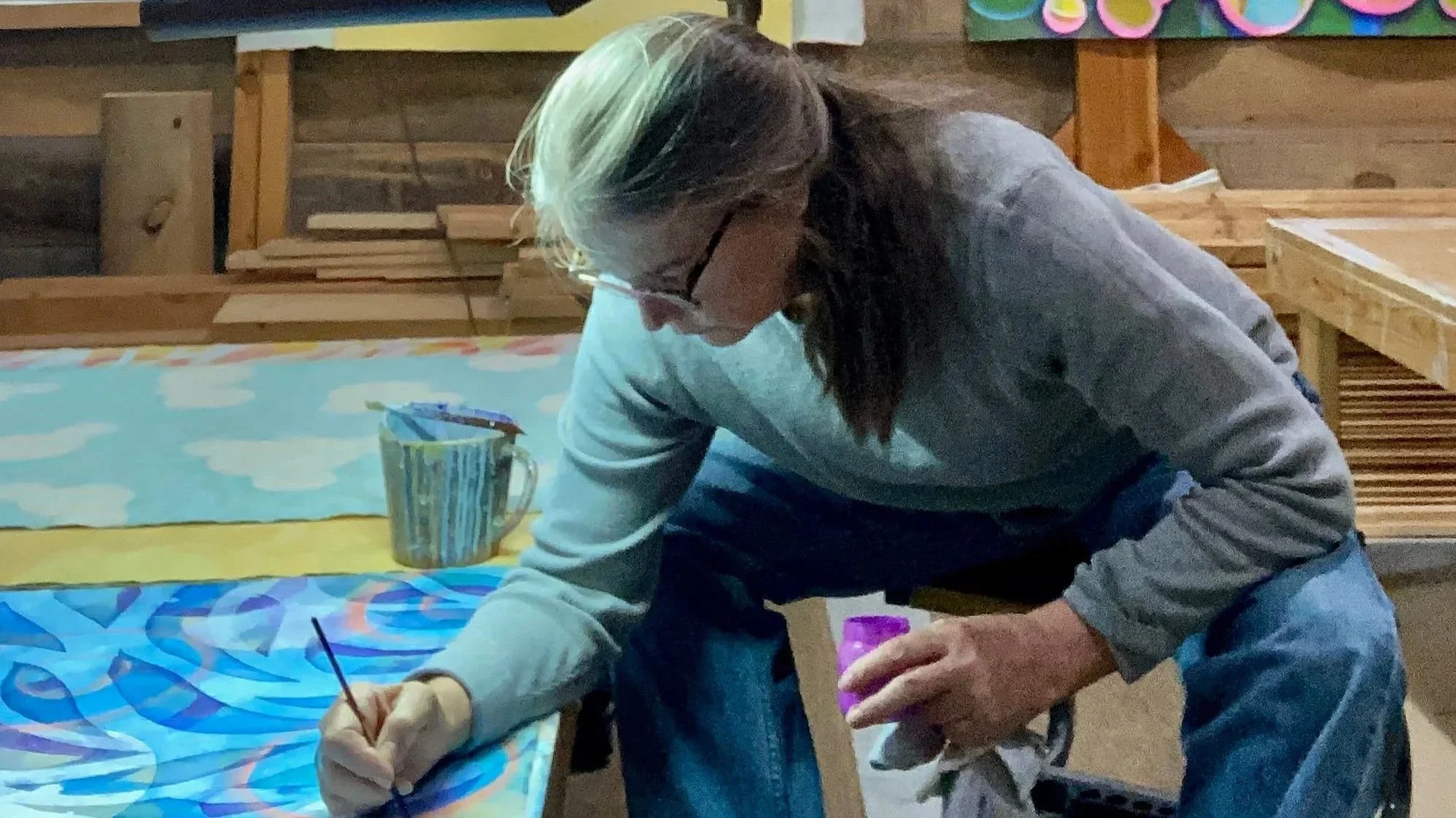
Working on flat, unstretched canvas, I build up dozens of layers of thin acrylic paint. Each pass is one color, applied with a brush, and dried completely before adding the next. Then the layers are interwoven by emphasizing shapes from deeper layers which creates surface tension and a sense of depth.
The technique is the jumping off point. Normally, I start out with an idea and some sketches and then work in groups - or series. The series are the “what”. What I’m trying to address or accomplish at each turn of the wheel.
-
I developed this technique as a student. When I first conceived of it, I asked friends to come to the studio and lie on the floor in various poses on unstretched canvas while I painted fields of color around them. But the use of models didn’t make it through the first painting. The idea was more interesting than the shapes I could make with people.
Since then, this method has produced an entire vocabulary of marks and shapes and continues to be the thread connecting my work through the decades, even as the imagery evolves.
-
I’m a big art lover and have a lot of favorites. That said, my work has been impacted by a few non-representational artists who have taken the physical qualities of paint and made it connect viscerally, like Morris Louis’ veil paintings and Pat Steir’s waterfalls. Lee Ufan’s retrospective blew my mind.
I’m also attracted to the rawness and connection to nature of Australian Aboriginal paintings. And Robert Goodnough’s layered and repeating shapes have stuck with me, as have Alma Thomas’ overpainting pieces.
-
Yes, I make non-objective paintings - or pictures without people or things that are based on formal qualities like color and motion.
When I started the Circle & Spheres series, I was thinking about forces like gravity, attract/repel, push/pull. But the compound circles were making increasingly complex shapes - becoming entities. I also started to model these shapes with light/shadow and they were sitting more centrally in the composition - almost like characters. That’s when I revisited some ideas in my sketchbooks with symbols and ventured into a version of representation.
Going forward, I remain interested in doing non-objective work. But never say never!